
Every AMR pilot looks the same at the start. One vendor, one fleet manager, a handful of robots running a milk run or two, everybody happy with the demo. Then the pilot works, the plant orders more robots, and somewhere around the second vendor or the second building, the conversation changes. Nobody’s asking about SLAM accuracy or battery swap cycles anymore. They’re asking why two fleets of robots keep stacking up at the same intersection, or why the WMS has to run three separate integrations to dispatch what should be one unified task queue.
That’s the real story in AMR deployment right now, and it’s not the story most vendors are telling. Navigation is solved. Battery life is solved well enough for most shifts. The bottleneck that’s actually slowing plants down as they scale past pilot is coordination — traffic arbitration, task allocation, and priority arbitration across fleet managers that were never designed to negotiate with each other.
The single-vendor fleet manager was never built for this
Every AMR vendor’s fleet manager does the same core job: it owns the map, owns traffic rules for its own robots, and owns task assignment for its own fleet. That works fine when it’s the only fleet manager on the floor. The moment you add a second vendor — maybe forklift-form-factor AMRs from one supplier and tugger-style AMRs from another, or a new vendor brought in because the first one didn’t have the right payload class — you now have two systems that each think they own the intersection.
Neither fleet manager sees the other’s robots as anything but an obstacle, if it sees them at all. Best case, you’re relying on physical zone segmentation and hoping nobody needs to cross the aisle. Worst case, you get deadlocks, robots parking mid-aisle waiting for a right-of-way negotiation that’s never going to happen, and a control room that’s manually re-routing traffic by radio — which more or less defeats the point of buying autonomous robots.
This isn’t a defect in any particular fleet manager. It’s a predictable consequence of vendors building vertically integrated stacks that were optimized for single-fleet performance, not multi-fleet arbitration. Plants running 20, 40, 60+ robots across multiple vendors are now hitting this wall in production, not in a lab.
Why VDA 5050 changes the calculus
VDA 5050 is the interface specification, originally driven by German automotive OEMs and now maintained through VDMA, that defines a common MQTT-based communication contract between AMRs (or their controllers) and a master control system. It standardizes how order messages, state reports, and visualization data move back and forth, regardless of which vendor built the robot underneath.
What’s changed in the last cycle isn’t the standard itself — VDA 5050 has been around for a while — it’s adoption depth. A meaningful share of AMR vendors now expose native VDA 5050 interfaces rather than treating it as a bolt-on afterthought, and the master-control side of the ecosystem (dedicated fleet orchestration platforms, plus modules from major automation and logistics software vendors) has matured enough to actually consume those interfaces reliably. That combination is what makes a neutral coordination layer a practical project in 2025-2026 rather than a science experiment.
The pattern looks like this: each vendor’s native fleet manager still runs the low-level stuff it’s good at — precise navigation, obstacle avoidance, charging logic, robot health. Above that sits a vendor-neutral master control layer that talks VDA 5050 to each fleet manager, arbitrates shared traffic zones, and hands out high-level tasks across whichever fleet is best positioned to take them. Nobody’s replacing the fleet managers. You’re adding a broker on top.
What this layer actually solves — and what it doesn’t
Be precise about the boundary here, because vendors selling coordination platforms will happily let you assume it does more than it does.
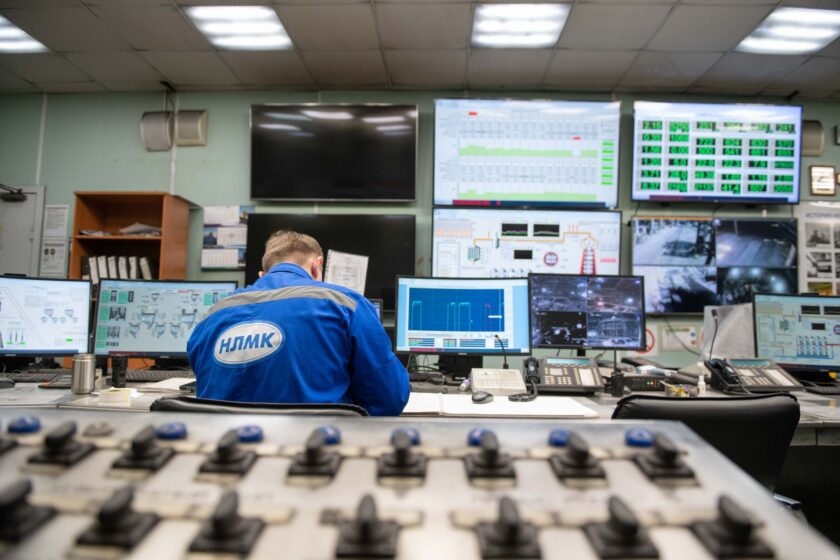
What it solves reasonably well: shared-zone traffic arbitration (who goes first through a doorway or narrow aisle when robots from different fleets both want it), unified task queuing so a WMS or MES can submit one work order without knowing which fleet will execute it, and consistent status visibility across fleets in one dashboard instead of three.
What it doesn’t solve automatically: map federation is still messy. VDA 5050 standardizes the messaging, not the underlying map format, so getting two vendors’ independently-built maps to agree on a shared coordinate system for a joint zone is typically a manual calibration effort, not a plug-and-play feature. Task allocation logic — deciding which fleet should get a given job based on cost, distance, or payload fit — is usually something you have to configure and tune yourself; the standard gives you the plumbing, not the optimization algorithm. And charging/resource contention across fleets (shared charging bays, shared elevators, shared narrow corridors with limited passing points) still needs deliberate design, often with custom logic layered on top of what the coordination platform ships out of the box.
Where MES task dispatch fits in
This is the part plant IT teams tend to miss until it bites them. If your MES is dispatching material moves directly to a single vendor’s fleet manager today, that integration doesn’t disappear when you add a coordination layer — it just moves up a level. Instead of the MES talking to Fleet Manager A’s API, it talks to the neutral orchestration layer, which then fans work out across fleets via VDA 5050.
That’s a real integration project, not a config change. You’re revisiting how work orders get translated into transport tasks, how completion and exception events flow back into your MES for genealogy and tracking, and how you handle the case where the coordination layer itself is unavailable — because now you’ve added a system that, if it goes down, can potentially stall multiple fleets instead of one. Plan for that failure mode explicitly: what’s the fallback when the broker is offline, and can individual fleet managers still run degraded, zone-restricted operations without it?
A decision framework: do you actually need this yet?
Single-vendor fleet management is still the right call for a lot of plants, and there’s no shame in staying there. Consider a neutral coordination layer when most of the following are true:
- You’re running or actively planning robots from more than one vendor in overlapping physical space, not just separate buildings with hard walls between them.
- Your fleet size is large enough that manual traffic management (radio calls, physical zone gates, staff intervention) is becoming a recurring labor cost or a recurring source of stalls.
- Your MES or WMS needs a single dispatch interface rather than vendor-specific integrations multiplying with each new fleet you add.
- You expect to keep adding vendors or robot classes over the next few years, and don’t want each addition to be its own bespoke integration project.
Stay single-vendor, at least for now, if you’ve got one fleet, one vendor, hard physical separation from any other automated equipment, and no near-term plan to diversify. Adding an orchestration layer in that situation is complexity you don’t need yet — it’s solving a coordination problem you don’t have.
If you’re straddling the line, the honest move is to pilot the coordination layer in a single contested zone — the one aisle or dock area where fleets actually cross paths — before rolling it out plant-wide. Confirm the VDA 5050 interfaces your vendors ship are current-spec and actually implemented against the features you need, not just checkbox-compliant. And treat the map federation and task-allocation tuning as the real work: that’s where the effort goes, not in standing up the broker itself.
This article was written with the assistance of artificial intelligence. While we aim for accuracy, the information may be incomplete, out of date, or incorrect, and should be independently verified before you rely on it for any decision. It is provided for general information only and does not constitute professional advice.